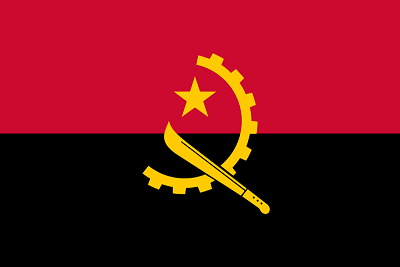
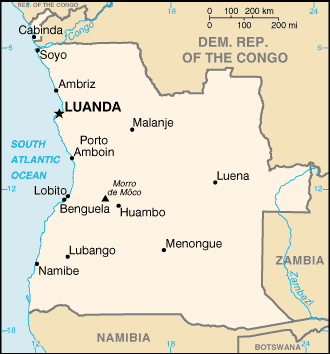
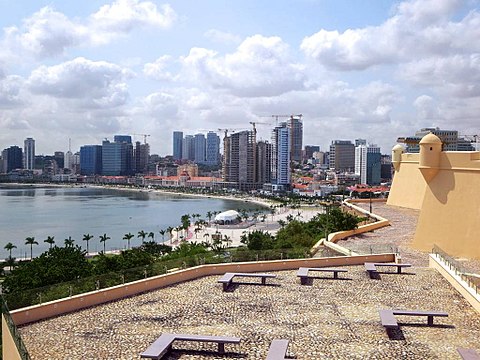
Republic of Angola, is a country on the west coast of Southern Africa. It is the second-largest Lusophone (Portuguese-speaking) country in both total area and population, and is the seventh-largest country in Africa. It has been inhabited since the Paleolithic Age. Its formation as a nation-state originates from Portuguese colonisation, which initially began with coastal settlements and trading posts founded in the 16th century. In the 19th century, European settlers gradually began to establish
Cities:
inhabitants
% pop
Area(km2)
Density
Luanda
11.370.127
29,1
1039
10.943
Lubango
1.280.986
3,3
169
7.580
Cabinda
1.157.345
3,0
103
11.236
Malanje
973.086
2,5
83
11.724
Luena
714.289
1,8
83
8.606
Cuito
689.795
1,8
79
8.732
Huambo
634.669
1,6
105
6.044
Benguela
589.289
1,5
96
6.138
Lobito
516.153
1,3
67
7.704
Saurimo
514.728
1,3
61
8.438
Moçâmedes
415.361
1,1
44
9.440
Uíge
408.927
1,0
50
8.179
Soyo
389.945
1,0
62
6.289
Ondjiva
347.591
0,9
49
7.094
M'banza Congo
334.203
0,9
32
10.444
Economy: It remains heavily influenced by the effects of four decades of conflict in the last part of the 20th century, the war for independence from Portugal (1961–75) and the subsequent civil war (1975–2002). Despite extensive oil and gas resources, diamonds, hydroelectric potential, and rich agricultural land, Angola remains poor, and a third of the population relies on subsistence agriculture. Since 2002, when the 27-year civil war ended, government policy prioritized the repair and improvement


 angola