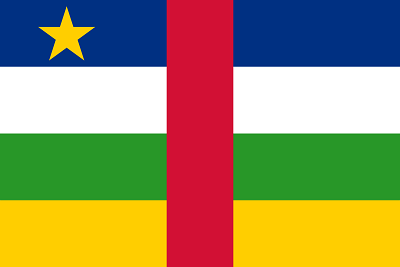
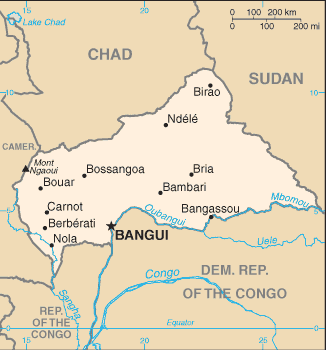
As of 2022, It is the scene of a civil war, ongoing since 2012. Most of the Central African Republic consists of Sudano-Guinean savannas, but the country also includes a Sahelo-Sudanian zone in the north and an equatorial forest zone in the south. Two-thirds is within the Ubangi River basin (which flows into the Congo), while the remaining third lies in the basin of the Chari, which flows into Lake Chad. After gaining independence from France in 1960, It was ruled by a series of autocratic leaders
Cities:
inhabitants
% pop
Area(km2)
Density
Bangui
1.056.950
19,2
119
8.882
Carnot
78.387
1,4
9
8.710
Bouar
62.700
1,1
13
4.823
Badokwa
60.959
1,1
12
5.080
Bambari
56.913
1,0
13
4.378
Nola
53.625
1,0
10
5.363
Economy: Sparsely populated and landlocked, the Central African Republic is overwhelmingly agrarian. The vast bulk of the population engages in subsistence farming and 55% of the country's GDP derives from agriculture. Subsistence agriculture, together with forestry, remains the backbone of the economy of the CAR, with more than 70% of the population living in outlying areas. Principal food crops include cassava, peanuts, sorghum, millet, maize, sesame, and plantains.


 central african republic