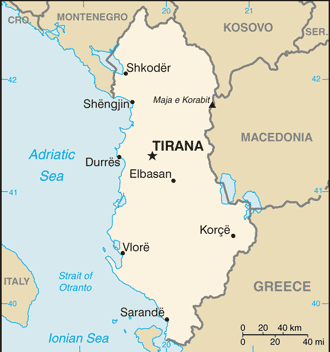
Tirana is its capital and largest city, followed by Durres, Vlore, and Shkoder. Albania displays varied climatic, geological, hydrological, and morphological conditions, defined in an area of 28,748 km2 (11,100 sq mi). It possesses significant diversity with the landscape ranging from the snow-capped mountains in the Albanian Alps as well as the Korab, Skanderbeg, Pindus and Ceraunian Mountains to the hot and sunny coasts of the Albanian Adriatic and Ionian Sea along the Mediterranean Sea
Cities:
inhabitants
% pop
Area(km2)
Density
Tiranë (Tirana)
833.020
30,1
105
7.934
Durrës
129.455
4,7
31
4.176
Shkoder
81.278
2,9
17
4.781
Vlora
77.215
2,8
21
3.677
Elbasan
74.628
2,7
14
5.331
Fier
56.284
2,0
8
7.036
Economy: It went through a process of transition from a centralized economy to a market-based economy on the principles of the free market. Albania's economy is based on the service (54.1%), agriculture (21.7%), and industrial (24.2%) sectors. The country has some natural resources, and the economy is mainly bolstered by agriculture, food processing, lumber, oil, cement, chemicals, mining, basic metals, hydro power, tourism, textile industry, and petroleum extraction.


 albania